
7 Steps You May Face After Failing a Roadside Drug Test in the UK
Published by Drug Driving Solicitors — specialist defence lawyers for drug driving charges across England and Wales.
Being stopped by police and asked to provide a roadside drug sample is a stressful experience, and the uncertainty of what happens next can make it even more unsettling. The process that follows a positive screening result is, however, a defined legal sequence, and understanding each stage can help you make informed decisions and avoid costly mistakes along the way.
This guide walks through seven key stages you may encounter after failing a roadside drug test in the UK. While every case has its own facts, the broad procedural framework is consistent across England and Wales, and knowing what to expect at each point is one of the most valuable things you can do for yourself early on.
Step 1: A Healthcare Professional Takes a Blood Sample
Why a Blood Sample Is Required
Once you are in police custody, the roadside swab result alone is not sufficient to charge you. The law requires a more precise form of evidence, and that comes in the form of a blood sample taken by a qualified healthcare professional. This is the specimen on which the prosecution will ultimately rely, making it one of the most consequential moments in the entire process.
The healthcare professional, typically a forensic medical examiner or custody nurse, attends the custody suite specifically to take the sample. The procedure is governed by strict legal and procedural requirements, and any departure from those requirements may later become relevant to your defence.
What the Procedure Involves
The blood draw itself is straightforward and usually takes only a few minutes. The sample is divided into two portions: one is retained by the police for laboratory analysis, and the other is offered to you. Accepting your portion matters, because it allows an independent expert instructed on your behalf to analyse the same sample if needed.
You will be asked to sign documentation confirming that you were offered your half of the sample. It is important to read what you are signing carefully and, ideally, to do so only after speaking to a solicitor. Custody staff are required to explain the process to you, and you are entitled to ask questions before proceeding.
Your Rights at This Stage
Key rights and considerations at the blood sample stage include:
- You have the right to speak to a solicitor, free of charge, before providing the sample
- The healthcare professional must confirm you have no medical condition that makes the procedure unsafe
- You should accept your half of the blood sample whenever it is offered
- Any concerns about the procedure should be raised calmly and noted at the time
Common Misunderstandings
Many people assume that refusing to provide blood is a way to avoid a conviction. It is not. Refusal without a reasonable excuse is a separate criminal offence carrying the same penalties as a drug driving conviction. The threshold for what constitutes a "reasonable excuse" is very narrow, and a genuine medical objection must be supported by evidence. If you have any concerns about providing a sample, speak to a solicitor before making a decision.
Step 2: The Officer Administers a Statutory Warning
What the Statutory Warning Is
Before you are required to provide a roadside oral fluid sample, the officer must deliver what is known as a statutory warning. This is a formal caution that informs you of the consequences of failing or refusing to cooperate with the screening process. It is not optional on the officer's part, and it is not a formality to be skimmed over.
The statutory warning is a legal prerequisite. If it is not administered correctly, or if it is omitted entirely, that procedural failure may provide grounds to challenge the admissibility of everything that follows. This is one of the first things a specialist solicitor will check when reviewing the circumstances of your case.
What the Warning Must Cover
The warning is required to inform you that:
- Failing to cooperate with the screening test is a criminal offence
- The results of the test may be used in evidence against you
- You may be required to provide further specimens if the roadside result is positive
- Refusing without a lawful excuse carries its own criminal penalties
How This Stage Can Affect Your Case
The precise wording and delivery of the statutory warning is a legitimate avenue of legal challenge. Officers are trained to administer it correctly, but errors do occur, and when they do, they can have real consequences for the strength of the prosecution's case. A specialist solicitor will obtain and review the officer's notes, body-worn camera footage, and custody records to establish exactly what was said and when.
What You Should Do at This Point
At the time the warning is administered, your most useful course of action is to listen carefully and remain composed. Note anything that seems unusual or incomplete. If you have a mobile phone available before the stop escalates, making a brief note of the time and what was said can be helpful later. Above all, do not argue with the officer at the roadside: your opportunity to raise any concerns about the process comes later, with legal representation behind you.
Step 3: Your Case Is Heard at the Magistrates' Court
How the Case Reaches Court
Once a charge has been laid, the matter is listed before the Magistrates' Court. Drug driving offences under Section 5A of the Road Traffic Act 1988 are summary offences, meaning they are dealt with at magistrates' level rather than the Crown Court. The first hearing is typically an arraignment or preliminary hearing at which you will be asked to enter a plea.
How you approach this hearing, and what preparation goes into it, can significantly affect the outcome. Whether you intend to plead guilty or contest the charge, attending with specialist legal representation is strongly advisable. The magistrates will expect a clear indication of your position, and any procedural or evidential arguments need to be raised at the right time and in the right way.
The Sentencing Range for Drug Driving
If convicted of a Section 5A drug driving offence, the court has a range of sentencing options available:
- A mandatory minimum driving disqualification of 12 months (longer for repeat offences)
- An unlimited fine, assessed by reference to your weekly income
- Up to six months' imprisonment in the most serious cases
- A requirement to complete an extended driving test before your licence is returned
- A DG10 endorsement on your licence, which remains visible for 11 years
Contesting the Charge
A not-guilty plea triggers a trial, typically listed some weeks after the first hearing. The prosecution must prove beyond reasonable doubt that the controlled drug was present in your blood above the specified limit at the time of driving. Defence avenues can include challenges to the roadside procedure, the chain of custody of the blood sample, the laboratory methodology, and, where applicable, the statutory medical defence for prescribed medication.
Why Specialist Representation Matters Here
The magistrates' court can feel deceptively informal compared to higher courts, but the consequences of a drug driving conviction are serious and long-lasting. A specialist solicitor will know which arguments carry weight with the court, how to cross-examine prosecution witnesses effectively, and how to present mitigation in a way that the bench will respond to. General criminal practitioners often lack the specific technical knowledge that drug driving cases require.
Step 4: The Roadside Device Produces a Positive Reading
How Roadside Drug Testing Works
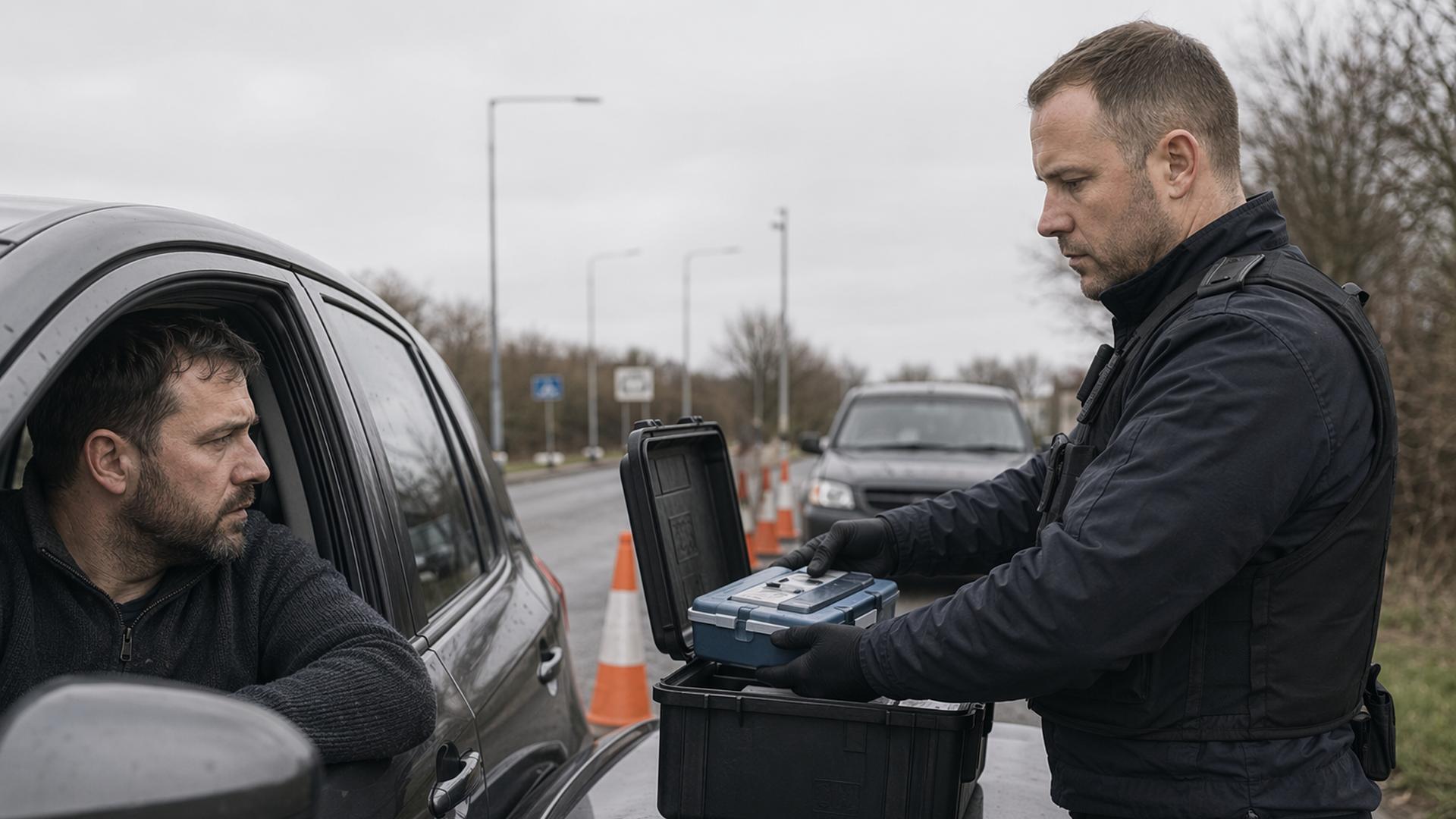
Police in England and Wales use type-approved oral fluid testing devices to screen drivers for the presence of controlled drugs. The most widely used device is the Draeger DrugTest 5000, which tests for cannabis and cocaine. A separate device, the Securetec DrugWipe 5S, is approved for testing heroin and methamphetamine. The officer places a collection stick in your mouth for a period of several minutes before inserting it into the device.
The device produces a result within a few minutes. A positive reading does not mean you are automatically guilty of an offence, nor does it mean the drug was necessarily at or above the legal limit in your bloodstream. The roadside test is a screening tool, not a confirmed evidential result, and it is important to understand that distinction from the outset.
What a Positive Reading Means in Practice
A positive roadside reading triggers the next stage of the process, but it is not, on its own, the basis for a prosecution. The key points to understand at this stage are:
- The roadside device indicates the presence of a substance, not its precise concentration
- The device may register a positive result for certain prescribed medications
- Cross-reactivity and calibration issues are recognised limitations of roadside devices
- The positive reading gives the officer grounds to proceed further, but it is not conclusive evidence
The Significance of Type Approval
Each roadside device is approved for use with specific substances only. An officer cannot rely on a positive result from a device that is not type-approved for the drug it is said to have detected. Type approval requirements are set out in statutory instruments, and any departure from those requirements is a proper ground for legal challenge. Your solicitor will verify which device was used and whether its use was lawful in the circumstances of your case.
Staying Calm at the Roadside
Receiving a positive result is alarming, but how you conduct yourself in the next few minutes matters. Do not attempt to explain or justify the result to the officer. Anything you say can be noted and may later be used in evidence. You are entitled to remain silent, and exercising that right calmly and politely is entirely lawful. Note the time, the location, and the name or number of the officer if you can do so discreetly. Your solicitor will need these details.
Step 5: You Are Arrested and Taken to a Custody Suite
The Arrest and What It Means
A positive roadside screening result gives the officer reasonable grounds to arrest you on suspicion of a drug driving offence. The arrest is made under Section 6D of the Road Traffic Act 1988, and the officer will caution you at this point using the standard "you do not have to say anything" caution. Being arrested is not the same as being charged, and it does not mean a prosecution is inevitable.
You will be searched and your personal property will be secured before you are transported to a police custody suite. Your vehicle may be left at the roadside or, in some circumstances, recovered by the police. If you have passengers in the car, arrangements will need to be made for them independently.
What Happens When You Arrive at Custody
On arrival at the custody suite, the custody sergeant will book you in and read you your rights. These include:
- The right to have someone informed of your arrest
- The right to consult a solicitor in private, free of charge
- The right to see the Codes of Practice governing your detention
- The right to be informed of the reason for your arrest and detention
The Importance of Requesting a Solicitor
Requesting a solicitor is one of the most important decisions you can make at this stage. The duty solicitor service is available 24 hours a day at no cost to you, and speaking to a specialist before you answer any questions or provide any specimens is strongly advisable. Anything said during voluntary questioning can form part of the prosecution's case, and a solicitor's role at this point is to ensure your rights are protected and that you do not inadvertently make your position worse.
How Long You Can Be Held
The police are permitted to detain you for an initial period of up to 24 hours without charge. This period is typically sufficient to complete the custody procedure in drug driving cases. Extensions beyond 24 hours require senior officer authorisation and are unusual in straightforward drug driving matters. Once the required procedures are completed, you will either be charged, released under investigation, or released with no further action at that stage.
Step 6: The Blood Sample Is Sent for Laboratory Analysis
The Chain of Custody Process
Once the blood sample has been taken and correctly packaged, it is submitted to a forensic science laboratory nominated by the relevant police force. The transportation and handling of the sample from the moment it leaves the custody suite to the moment it arrives at the laboratory is governed by strict chain of custody protocols. These protocols exist to ensure the integrity of the sample and to prevent any suggestion of tampering or contamination.
The chain of custody documentation records every person who handles the sample, the conditions under which it was stored, and the dates and times of each transfer. Any gap or irregularity in this chain is something a specialist solicitor will scrutinise closely, because breaks in chain of custody can render the laboratory result inadmissible.
What the Laboratory Is Looking For
The laboratory analysis goes significantly further than the roadside screening. Using techniques such as liquid chromatography-tandem mass spectrometry (LC-MS/MS), the laboratory quantifies the precise concentration of any controlled drug present in the sample. The result is then compared against the specified limits set out in the Drug Driving (Specifed Limits) (England and Wales) Regulations 2014.
The specified limits vary considerably by substance:
- Delta-9-tetrahydrocannabinol (cannabis): 2 micrograms per litre of blood
- Cocaine: 10 micrograms per litre of blood
- Benzoylecgonine (cocaine metabolite): 50 micrograms per litre of blood
- Heroin metabolite (6-monoacetylmorphine): 5 micrograms per litre of blood
How Long Analysis Takes
Laboratory analysis is typically the longest single stage in the process. Turnaround times vary depending on the laboratory's workload and the complexity of the sample, but it is not unusual for results to take several weeks to several months to be returned. During this period, you may be on police bail or released under investigation with no specific reporting conditions attached to your driving.
Using Your Half of the Sample
If you accepted your portion of the blood sample at the custody suite, you can instruct an independent forensic toxicologist to analyse it. This is a powerful tool in your defence because it allows your legal team to obtain a result that is entirely independent of the prosecution's evidence. Discrepancies between the two results can be highly significant. If the two analyses produce materially different figures, the reliability of the prosecution's sample becomes a live issue at trial.
Step 7: You Are Charged or Told No Further Action Will Be Taken
How the Charging Decision Is Made
Once the laboratory report is received by the police, the results are reviewed and a charging decision is made. In straightforward cases, this decision is made by the officer in charge or a senior reviewing officer. In more complex matters, it may be referred to the Crown Prosecution Service for a charging decision under the Code for Crown Prosecutors. The two-part test applied is whether the evidence meets the evidential threshold and, if so, whether a prosecution is in the public interest.
A decision that no further action will be taken is not the same as an acquittal, but it does mean the investigation is closed and no charge will follow. You will receive formal written notification of this outcome. If you are charged, a charge sheet or requisition will be issued setting out the specific offence alleged.
What "Released Under Investigation" Means
Between the blood test and the charging decision, many people find themselves in a period of uncertainty described as being "released under investigation" (RUI). This means:
- The investigation is ongoing but you are not on formal bail
- You are not required to report to a police station on specific dates
- There is no fixed legal deadline by which a decision must be made
- The investigation can, in theory, continue for a significant period
Your Options After Being Charged
If you are charged with a drug driving offence, you will be given a date to attend the Magistrates' Court. You will need to decide, ideally with legal advice, how to respond to the charge. The options are:
- Enter a guilty plea, which may reduce the severity of the sentence
- Enter a not-guilty plea and contest the charge at trial
- Seek further disclosure from the prosecution before entering a plea
- Explore whether a statutory medical defence applies to your circumstances
The Value of Early Legal Advice
Receiving a charge is not the end of the road, and the way you respond to it matters enormously. Specialist drug driving solicitors can review the prosecution's evidence package, identify weaknesses, and advise you on the realistic prospects of a successful defence before you commit to a plea. Early engagement with legal representation is almost always more beneficial than waiting until the court date arrives.
Understanding Your Position Before Court
Navigating the aftermath of a failed roadside drug test involves a sequence of legal stages, each with its own rules, rights, and risks. Being well-informed at every step, and taking specialist legal advice as early as possible, is the most reliable way to protect your position. Whether you are at the very beginning of this process or already facing a court date, the decisions you make now will shape the outcome of your case.
Frequently Asked Questions
How Long Does It Take From Failing a Roadside Drug Test to Being Charged?
The timeline from a failed roadside test to a charging decision generally falls somewhere between two and six months, though some cases take longer. The principal cause of delay is the laboratory analysis of the blood sample, which depends on the capacity and workload of the force's nominated forensic provider. Once the laboratory report comes back, the decision to charge or take no further action is usually made relatively promptly. If six months have passed since the incident and you have received no update, it is worth seeking specialist legal advice to understand where you stand.
What if the Drug Found in My Blood Was Prescribed by My Doctor?
A statutory medical defence exists under Section 5A(3) of the Road Traffic Act 1988. To rely on it, a driver must show that the drug was lawfully prescribed or supplied to them, that they took it in accordance with their medical advice, and that their driving was not impaired at the time. While the defence is available, it is narrower in practice than many people expect. It must be properly evidenced and presented in the correct way. Drug Driving Solicitors has particular expertise in cases involving prescription medication and can advise on the strength of a medical defence in your specific circumstances.
Will a Drug Driving Conviction Affect My Employment?
A drug driving conviction can have significant employment consequences depending on your occupation and the terms of your contract. Many employers require disclosure of criminal convictions, and roles that involve driving, working with children or vulnerable adults, or holding a professional licence may be directly affected. Some professional regulatory bodies, such as those overseeing healthcare workers, solicitors, and teachers, require disclosure and may take their own disciplinary action separately from any court outcome. A specialist solicitor can help you understand the full picture before you enter a plea, so that you are making decisions with a clear view of what a conviction could mean for your career.
What Are the Most Common Reasons Drug Driving Charges Are Dropped?
The most frequent grounds on which charges are discontinued or defendants are acquitted include: the statutory warning not being administered correctly before the roadside swab was requested; use of a device that was not type-approved for the specific drug in question; irregularities in the chain of custody of the blood sample; failure to offer the defendant their portion of the blood sample; errors in the laboratory analysis; and unlawful stop and search. A specialist solicitor will examine all of these points as a matter of course, not merely the headline blood test result.
What Is a DG10 and How Long Does It Stay on My Licence?
DG10 is the DVLA offence code applied following a conviction for driving or attempting to drive with a controlled drug above the specified limit under Section 5A of the Road Traffic Act 1988. Once recorded, it remains on your driving licence for 11 years from the date of conviction and is visible to any insurer who checks the DVLA database. Insurance premiums typically rise sharply as a result. The knock-on effects of a DG10 can extend to employment, overseas travel, and professional licensing. A specialist solicitor can advise on the full range of consequences for your particular circumstances before you commit to a course of action.
What Happens if I Refuse to Give a Blood Sample at the Custody Suite?
Refusing to provide a specimen without a reasonable excuse is a criminal offence in its own right under Section 7A of the Road Traffic Act 1988. The penalties are the same as for a drug driving conviction, including the mandatory 12-month driving ban. The definition of a "reasonable excuse" is interpreted very narrowly by the courts, and any medical reason put forward must be supported by credible evidence. Refusing to cooperate is not a risk-free route out of the situation. Before making any decision about whether to provide a sample, speak to a solicitor.
Drug Driving Solicitors is a dedicated law firm handling drug driving cases throughout England and Wales. If you have received a positive roadside test result and want to understand where you stand, contact us for a free initial consultation or visit drugdrivingsolicitors.co.uk. Taking advice at the earliest opportunity is cost-free and can make a meaningful difference to how your case is resolved.